
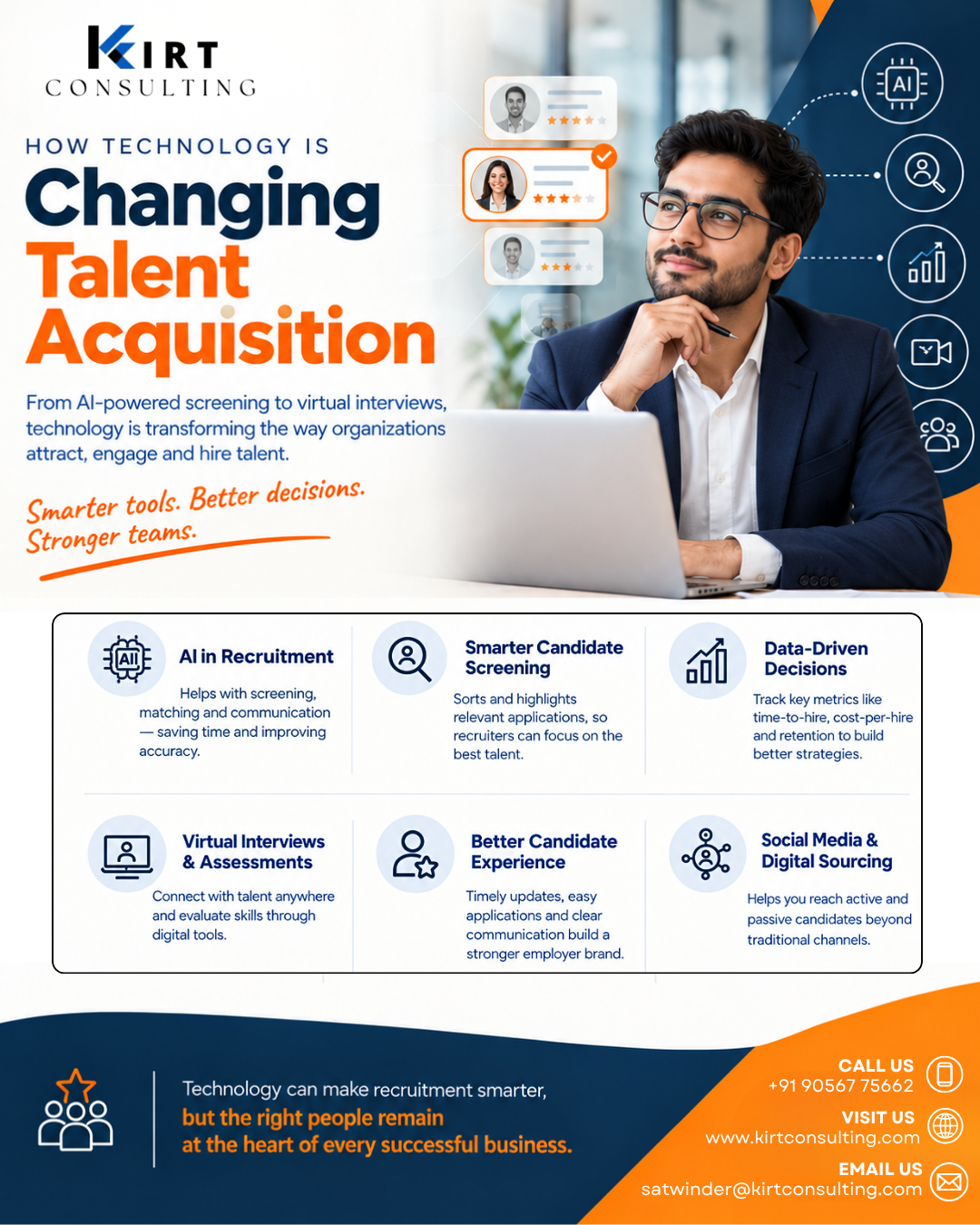
How Technology Is Changing Talent Acquisition
Technology is reshaping the talent acquisition landscape, enabling organizations to enhance how they attract, identify, assess, and hire talent. Digital recruitment platforms, Artificial Intelligence (AI), automation, and data-driven insights are increasingly becoming integral to recruitment strategies, supporting greater efficiency, informed decision-making, and improved hiring outcomes.
Today, talent acquisition extends beyond fulfilling immediate hiring requirements. It is a strategic business function focused on identifying the right talent, enhancing the candidate experience, and building a skilled, future-ready workforce aligned with long-term organizational objectives.
At Kirt Consulting, we combine evolving recruitment practices with a consultative, people-centric approach to help organizations identify, engage, and attract the right talent. Our focus is on aligning talent acquisition strategies with business priorities to support sustainable growth and long-term organizational success.
1. Artificial Intelligence in Recruitment
Artificial Intelligence (AI) is increasingly enhancing recruitment efficiency by automating routine tasks such as CV screening, candidate matching, job description development, and recruitment-related communication. These capabilities enable recruiters to streamline hiring processes, improve operational efficiency, and identify candidates whose skills, experience, and competencies align with specific role requirements.
By reducing the time spent on administrative activities, AI allows recruitment professionals to focus on strategic priorities, including candidate engagement, competency assessment, and informed hiring decisions.
However, technology must complement rather than replace human expertise. Effective talent acquisition requires recruiters to critically evaluate AI-generated recommendations, identify potential biases, and maintain transparency, fairness, and accountability throughout the hiring process. A balanced integration of AI and human judgment is essential to achieving responsible, consistent, and quality-driven recruitment outcomes.
2. Faster and Smarter Candidate Screening
Managing high volumes of job applications can present significant challenges in terms of time, resources, and screening consistency. Recruitment technology enables organizations to streamline application management, assess relevant qualifications, and identify candidates who meet the essential criteria for a role.
These capabilities support a more structured and efficient initial screening process, particularly for organizations managing multiple vacancies across functions, locations, or business units.
A well-defined screening framework also enables recruiters to look beyond CV keywords and evaluate candidates based on relevant experience, practical skills, competencies, and overall suitability for the position. This approach facilitates more informed candidate shortlisting and strengthens the quality and consistency of recruitment decisions.
3. Data-Driven Hiring Decisions
Recruitment Analytics: Driving Data-Informed Talent Acquisition
Recruitment analytics enables organizations to evaluate hiring performance, assess process effectiveness, and make informed talent acquisition decisions through measurable data and actionable insights.
Key recruitment metrics include:
- Time-to-Hire: Measuring the efficiency of the hiring process.
- Cost-per-Hire: Evaluating recruitment expenditure and cost efficiency.
- Candidate Conversion Rates: Assessing candidate progression across recruitment stages.
- Offer Acceptance Rates: Understanding the effectiveness of offer management and candidate engagement.
- Employee Retention: Evaluating hiring outcomes through long-term employee retention.
- Quality of Hire: Assessing the contribution and performance of new hires against organizational expectations.
By leveraging these insights, organizations can identify process inefficiencies, optimize recruitment strategies, evaluate sourcing channel effectiveness, and strengthen overall hiring outcomes.
The objective of recruitment analytics extends beyond improving hiring speed. It is about enhancing the quality of hiring decisions, optimizing recruitment investments, and aligning talent acquisition outcomes with broader business objectives.
4. Virtual Interviews and Digital Assessments
Digital Recruitment: Enhancing Accessibility and Hiring Efficiency
Video interviews and online assessments have strengthened the recruitment process by enabling organizations to engage with talent across geographies, while improving operational efficiency and accessibility.
Virtual interviews offer greater scheduling flexibility, reduce travel-related requirements, and enable organizations to access a broader and more diverse talent pool. Similarly, digital assessments facilitate the evaluation of role-specific competencies and job-related skills, depending on the assessment methodology and position requirements.
To maximize the effectiveness of digital recruitment, organizations must prioritize transparent communication, provide reasonable accommodations where required, and maintain consistent, objective, and equitable assessment standards throughout the hiring process.
The focus is on leveraging digital recruitment capabilities to expand talent access, enhance process efficiency, and deliver a fair and consistent candidate experience.
5. Better Candidate Experience
Technology-Enabled Recruitment: Elevating the Candidate Experience
Technology has significantly reshaped candidate expectations, placing greater emphasis on process transparency, timely communication, and a seamless application experience. Candidates increasingly value structured recruitment processes, regular progress updates, and clarity at every stage of the hiring journey.
Technology-enabled solutions, including automated acknowledgements, interview scheduling tools, and Applicant Tracking Systems (ATS), enable recruiters to streamline communication, improve process efficiency, and minimize avoidable delays.
A positive candidate experience is a critical component of an organization’s employer brand. The quality of engagement throughout the recruitment process can influence candidates’ perceptions of the organization, irrespective of the final hiring outcome.
By combining technology with responsive communication and a structured recruitment approach, organizations can strengthen candidate engagement, reinforce their employer brand, and build lasting talent relationships.
6. Social Media and Digital Talent Sourcing
Digital Talent Sourcing: Expanding Access to Qualified Talent
Talent acquisition has evolved beyond traditional job advertisements and application-driven recruitment. Professional networking platforms, digital communities, and online talent databases have expanded sourcing capabilities, enabling recruiters to identify and engage relevant talent across a broader range of channels.
These platforms facilitate access to both active job seekers and passive candidates who may be receptive to suitable career opportunities, allowing organizations to build stronger talent pipelines and adopt a more targeted approach to recruitment.
A well-defined digital presence also enables organizations to communicate their employer value proposition, workplace culture, career growth opportunities, and organizational values, strengthening their positioning in an increasingly competitive talent market.
By leveraging digital sourcing channels strategically, organizations can broaden talent reach, enhance candidate engagement, and build sustainable talent pipelines aligned with their business and workforce priorities.
7. Challenges of Technology in Talent Acquisition
Balancing Recruitment Technology with Human Judgment
While technology continues to enhance recruitment efficiency and scalability, its adoption also presents challenges that require careful consideration. Key concerns include data privacy, cybersecurity, algorithmic bias, the accuracy of automated screening, and excessive reliance on technology-driven decision-making.
Although digital tools can support candidate evaluation, they cannot independently capture the full spectrum of human attributes, including motivation, adaptability, collaboration, cultural alignment, and long-term growth potential.
An effective talent acquisition strategy therefore requires a balanced integration of technology and human expertise. Combining digital capabilities with professional judgment, ethical practices, and transparent decision-making enables organizations to maintain fairness, improve assessment quality, and make informed hiring decisions aligned with business requirements.
The objective is to leverage technology as an enabler of better recruitment outcomes, while retaining the human insight and accountability essential to effective talent acquisition.
The Future of Talent Acquisition
The Future of Talent Acquisition: Integrating Technology with Human Expertise
As recruitment technology continues to advance, organizations will have increasing opportunities to strengthen talent sourcing, optimize recruitment processes, and drive data-informed hiring decisions. Digital solutions will continue to play a pivotal role in enhancing operational efficiency, improving access to talent, and aligning recruitment strategies with evolving business priorities.
However, sustainable talent acquisition extends beyond technological capabilities. A thorough understanding of people, organizational culture, and workforce requirements remains fundamental to identifying and engaging the right talent.
Organizations that strategically leverage digital tools while prioritizing meaningful candidate engagement, ethical practices, and human judgment will be better positioned to attract high-quality talent, strengthen their employer value proposition, and respond effectively to evolving workforce demands.
The future of talent acquisition lies in the strategic integration of technology, data, and human expertise to deliver sustainable talent outcomes and long-term business value.
Final Thoughts
Technology-Enabled Talent Acquisition: Driving Strategic Hiring Outcomes
Technology is transforming talent acquisition by enhancing connectivity, strengthening data-driven decision-making, and improving recruitment efficiency. From AI-assisted candidate screening and virtual interviews to recruitment analytics, digital solutions are redefining how organizations identify, evaluate, and engage talent.
However, the true value of recruitment technology lies not merely in its adoption, but in its strategic application to business priorities. When integrated effectively with recruitment expertise and human judgment, technology can improve hiring effectiveness, optimize processes, and strengthen overall talent acquisition outcomes.
At Kirt Consulting, we partner with organizations to deliver Recruitment, Executive Search, Head Hunting, Recruitment Process Outsourcing (RPO), and HR Transformation solutions. Our approach combines industry expertise, technology-enabled capabilities, and a consultative understanding of business requirements to help organizations build stronger talent pipelines and enhance workforce effectiveness. Technology enables smarter talent acquisition; strategic insight and the right talent create sustainable business value.

Leave A Comment