What Does It Really Take to Succeed at Workplace?
Securing a role with a leading organization is an exciting career milestone—but getting hired is just the beginning. Long-term success depends on how effectively you adapt to the organization, contribute to its goals, communicate with confidence, collaborate with others, and continuously develop your skills.
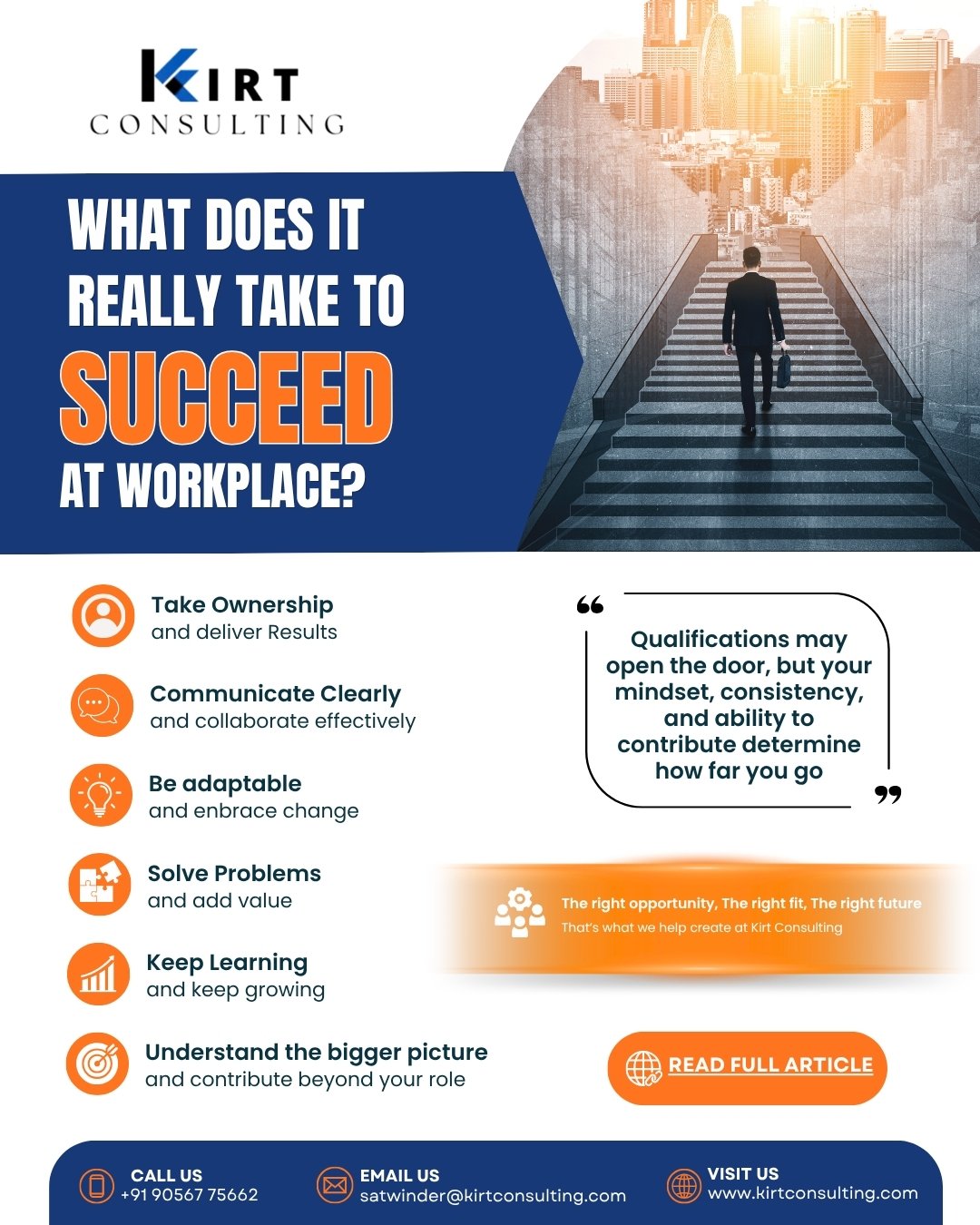
Leading companies look beyond academic qualifications and technical expertise. They seek professionals who can think critically, solve problems, take ownership, collaborate effectively, adapt to change, and consistently create value. The ability to learn, grow, and make a meaningful contribution is what transforms a new opportunity into a successful and sustainable career.
So, what does it really take to succeed at workplace?
1. Strong Skills Are Only the Starting Point
Technical expertise and professional experience may help you secure an interview, but continuous learning is what helps you build a successful career.
Industries, technologies, and business needs are constantly evolving. Professionals who stay curious, adaptable, and committed to learning are better equipped to take on new challenges, embrace changing responsibilities, and remain relevant in a competitive workplace.
Continuous development means:
- Staying updated with industry trends and developments
- Learning new tools, technologies, and emerging skills
- Strengthening both technical and interpersonal capabilities
- Seeking constructive feedback and turning it into opportunities for improvement
- Building new competencies that align with evolving business needs
Continuous learning enables professionals to stay relevant, create greater value, and grow alongside the organizations they work for.
2. Understand the Company’s Goals
High-performing professionals don’t simply focus on completing their assigned responsibilities—they understand the bigger picture. They recognize how their work impacts their team, customers, and the organization’s overall objectives.
Before making a decision, taking on a task, or starting a new project, ask yourself:
“How does this work create value and help my team, customers, or organization achieve its goals?”
Understanding the bigger picture allows you to make better decisions, prioritize effectively, and contribute beyond your immediate responsibilities.
3. Take Ownership of Your Work
One of the qualities that consistently sets successful professionals apart is a strong sense of ownership. Taking. It involves proactively identifying challenges, taking initiative, ownership means being accountable for outcomes—not simply completing tasks or following instructions and staying committed to delivering results.
Instead of saying, “That’s not my responsibility,” high-performing professionals look for ways to address the issue, support their team, and keep work moving forward. Professionals who demonstrate accountability, initiative, and reliability earn the trust of their colleagues and leaders. Over time, this trust often leads to greater responsibilities, leadership opportunities, and career growth.
4. Communication Matters More Than You Think
Technical expertise can open doors, but effective communication is essential for long-term career growth. Even highly skilled professionals can find their growth limited when they struggle to communicate clearly. Successful professionals know how to communicate with confidence and clarity across different audiences—including colleagues, managers, clients, and key stakeholders.
Effective communication involves:
- Listening actively and understanding different perspectives
- Asking clear, relevant, and thoughtful questions
- Sharing information and progress proactively
- Simplifying complex ideas so they are easy to understand
- Giving and receiving constructive feedback positively
- Adapting communication to different people and situations
Strong communication builds trust, minimizes misunderstandings, strengthens collaboration, and enables teams to work more effectively toward shared goals.
5. Learn to Work With Different People
Leading organizations bring together professionals with diverse backgrounds, experiences, perspectives, cultures, and areas of expertise.
In such dynamic workplaces, the ability to collaborate effectively with different personalities and working styles is essential for success. Successful professionals value diverse perspectives, participate constructively in discussions, support their colleagues, and remain focused on achieving shared objectives.
You don’t have to agree with everyone—but you should be able to respect different viewpoints, communicate professionally, and work effectively with everyone.
6. Be Adaptable
Change is an inevitable part of today’s workplace.
Organizations continuously evolve by adopting new technologies, restructuring teams, introducing new products and services, entering new markets, and adapting strategies to meet changing customer and business needs.
Professionals who are resistant to change may find it challenging to keep pace with an evolving work environment. In contrast, those who remain flexible, open-minded, and solution-oriented are better positioned to navigate uncertainty and identify new opportunities.
Adaptability doesn’t mean accepting every change without question. It means understanding the reasons behind change, learning quickly, adjusting your approach, and responding positively and constructively to new situations.
7. Develop a Problem-Solving Mindset
Managers value professionals who go beyond identifying problems and take the initiative to find practical solutions. When you encounter a challenge, instead of simply reporting the issue, approach your manager with a solution-oriented mindset:
“Here’s the challenge I’ve identified, and here are two possible approaches we could consider to resolve it.” This demonstrates initiative, critical thinking, analytical ability, and accountability while showing that you are focused on moving things forward.
Over time, developing a strong problem-solving mindset can set you apart from professionals who depend heavily on step-by-step instructions and help position you as a reliable, proactive, and valuable member of the organization.
8. Ask for Feedback
Feedback is one of the most powerful tools for professional growth.
Rather than waiting for an annual performance review, make feedback a regular part of your development. Proactively ask managers, mentors, or colleagues for honest input on how you can improve and perform more effectively.
For example:
“What is one thing I could do differently to improve my performance in this role?”
Constructive feedback may not always be easy to hear, but professionals who remain open to it and act on the insights are more likely to learn, improve, and progress faster in their careers.
The goal is not to avoid mistakes—it is to learn from them, improve your approach, and become better with every experience.
9. Build Professional Relationships
Long-term success within an organization is rarely achieved alone.
Building meaningful professional relationships can help you learn faster, collaborate more effectively, and gain a broader understanding of the business beyond your immediate role. Internal networking is not about connecting with people only when you need something. It is about building genuine, mutually supportive relationships over time.
Make it a habit to:
- Support colleagues whenever you can
- Participate actively in team and cross-functional discussions
- Share knowledge, ideas, and useful resources
- Take an interest in how other teams and functions operate
- Recognize and appreciate the contributions of others
Strong professional relationships build trust and create opportunities for collaboration, mentorship, knowledge sharing, and career growth. In the long run, the professional network you build within an organization can become one of your most valuable career assets.
10. Understand Workplace Culture
Every organization has its own unique culture, working style, and expectations.
Some companies prioritize speed, innovation, and experimentation, while others place greater emphasis on structure, accuracy, processes, and consistency. Some encourage employees to make independent decisions, while others rely on collaboration and collective decision-making.
Understanding these differences can make your transition into a new organization smoother and more successful.
Take time to observe how high-performing employees communicate, make decisions, manage challenges, collaborate with colleagues, and interact with leadership.
The goal isn’t to change who you are—it’s to understand the environment and adapt your approach so you can work effectively, build strong relationships, and contribute with confidence.
11. Focus on Results, Not Just Activity
Being busy doesn’t always mean being productive. True productivity is about creating meaningful outcomes, not simply staying occupied. Successful professionals understand which priorities matter most and focus their time and energy on activities that contribute to measurable business results.
Instead of asking:
“How many tasks did I complete?”
Ask yourself:
“What meaningful impact did my work create?”
Where possible, measure your contribution through tangible outcomes such as:
- Revenue generated or business opportunities created
- Costs reduced or resources optimized
- Processes improved or efficiencies increased
- Customers supported and satisfaction enhanced
- Projects delivered successfully and on time
- Problems resolved effectively
- Time saved through better ways of working
A results-oriented mindset shifts the focus from activity to impact—making your contribution more visible, valuable, and aligned with organizational goals.
12. Maintain Professionalism and Integrity
Your professional reputation matters.
The way you conduct yourself at work—through reliability, integrity, punctuality, confidentiality, accountability, and respect—shapes how colleagues, managers, and leaders perceive you.
Organizations value professionals they can trust, depend on, and rely upon, especially when handling important responsibilities and challenges.
Build your reputation by keeping your commitments, taking responsibility for mistakes, maintaining confidentiality, and treating everyone with professionalism and respect—regardless of their position or seniority.
Your skills and experience may help you secure an opportunity, but your character, consistency, and integrity determine the reputation you build and the trust you earn over time.
13. Think Beyond Your Current Role
Career growth doesn’t happen by chance—it requires awareness, continuous development, and intentional effort.
Successful professionals regularly evaluate where they are today and where they want to go next. They ask themselves:
- What skills do I need to develop for the next level?
- What additional responsibilities can I take ownership of?
- Where are the gaps in my knowledge or experience?
- Who can I learn from or seek guidance from?
- Which projects or experiences can help accelerate my growth?
You don’t have to constantly chase promotions or job titles. What matters is having a clear sense of direction and consistently building the skills, experience, and capabilities needed for your next career milestone.
A clear career direction helps you make smarter choices, recognize growth opportunities, and take greater ownership of your professional journey.
What Top Companies Really Look For
While hiring expectations differ across industries and organizations, leading companies increasingly value professionals who bring more than qualifications and technical expertise. They look for individuals who demonstrate a strong combination of:
Competence + Accountability + Adaptability + Communication + Collaboration + Continuous Learning
Qualifications and experience may help you secure the opportunity, but these qualities often determine how effectively you perform, grow, and create value once you are inside the organization.
In today’s evolving workplace, what you bring to the role—and how you continue to develop—can be just as important as the qualifications that helped you get there.
Final Thoughts
There is no single formula for success in the workplace.
Professionals who achieve consistent growth are often those who remain curious, dependable, adaptable, accountable, and committed to continuous development.
Focus on becoming more than someone who simply performs a role. Strive to be a professional who creates value, takes initiative, supports the team, solves problems, and contributes meaningfully to the organization’s success.
At Kirt Consulting, we believe successful careers begin with connecting the right talent to the right opportunities. Through our expertise in Recruitment, Executive Search, Headhunting, RPO, and HR Transformation, we work closely with organizations and professionals to build meaningful, long-term talent partnerships. Looking for your next career opportunity? Explore current openings with Kirt Consulting and discover roles that align with your experience, skills, career goals, and aspirations.
